
A new tool in IBD monitoring — and what it means for you.
Written by Dr. Antonia Repollet
Licensed Clinical Psychologist
Certified School Psychologist
GI Psychology
If you have been living with Crohn’s disease or ulcerative colitis, you are likely familiar with the monitoring tools that come with the territory: colonoscopies, MRIs, CT scans, blood draws, stool tests. These are the standard ways your care team tracks what is happening inside your intestines, and for good reason — Inflammatory Bowel Disease (IBD) is a disease that requires ongoing surveillance even when you are feeling well.
But a newer tool has been gaining significant traction in IBD care, and it may change the way monitoring feels for many patients: intestinal ultrasound, or IUS. It is non-invasive, radiation-free, and can be done in a clinic visit without any preparation. For patients who have spent years dreading their next scope, it represents a meaningful shift.
This post explains what intestinal ultrasound is, how it works, what to expect if your provider recommends it, and why researchers and clinicians are increasingly excited about its role in IBD management.
What Is Intestinal Ultrasound?
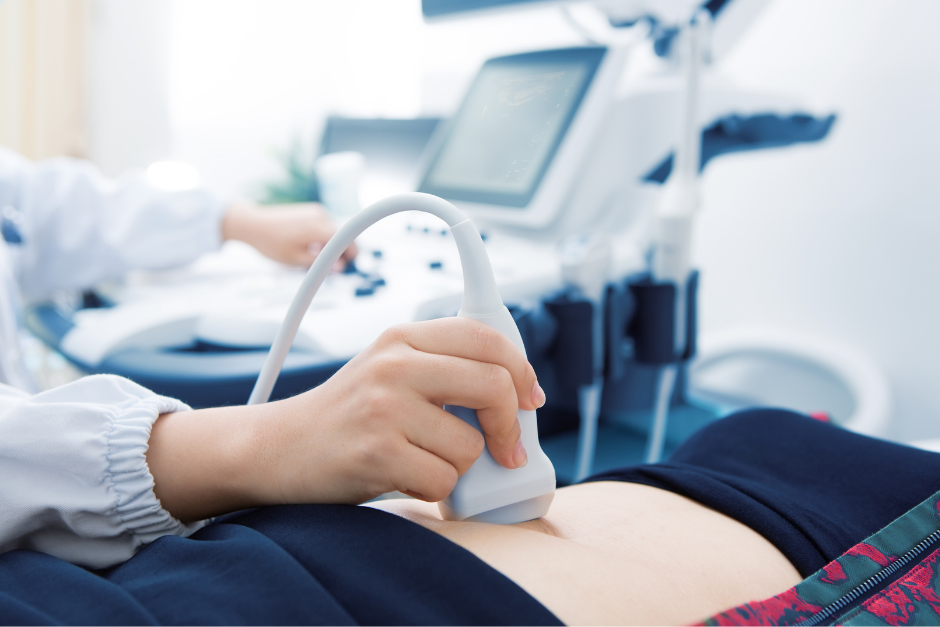
Intestinal ultrasound is a non-invasive imaging technique that uses high-frequency sound waves to visualize the walls of the intestines in real time (Frias-Gomes et al., 2021). It is the same basic technology as the ultrasound used in obstetrics or to evaluate the heart — a handheld probe is placed against the skin, and the sound waves create images of the structures underneath.
What makes IUS specific to IBD is the focus on intestinal wall thickness, the layers of the bowel wall, and surrounding structures. In active IBD, the intestinal wall becomes thickened and inflamed. IUS can detect this thickening, assess blood flow to the affected tissue, and evaluate features like creeping fat — a type of fatty tissue that wraps around the bowel and is associated with Crohn’s disease specifically (Abu Hamad & Gergely, 2026).
Importantly, IUS can assess both small bowel and large bowel segments, making it relevant for both Crohn’s disease and ulcerative colitis, though its utility varies somewhat by disease location and individual anatomy.
How Does It Compare to Other Monitoring Tools?
This is one of the most common questions patients ask, and it is a reasonable one. Colonoscopy remains the gold standard for directly visualizing the mucosal lining of the colon and obtaining tissue for biopsy. MRI enterography provides excellent detail for small bowel Crohn’s. CT scans are often used in acute or emergency settings. These tools are not going away, and IUS is not intended to replace them.
What IUS offers is something different: a fast, accessible, repeatable snapshot that does not require sedation, bowel preparation, radiation, or extended clinic time (Maaser et al., 2019). A skilled sonographer or gastroenterologist trained in IUS can complete the assessment in approximately 15 to 20 minutes. For patients who need more frequent monitoring — to assess treatment response, for example — this lower burden matters enormously.
Research has shown that IUS has strong accuracy in detecting active intestinal inflammation and transmural healing, which refers to healing across all layers of the bowel wall rather than only at the mucosal surface (Frias-Gomes et al., 2021). Transmural healing is increasingly recognized as an important treatment target in IBD, and IUS may be one of the most practical tools for tracking it over time (Abu Hamad & Gergely, 2026).
What to Expect During an Intestinal Ultrasound
For patients who have undergone colonoscopies or MRIs, the contrast with IUS is notable from the moment of scheduling.
There is no bowel preparation required. You do not need to follow a special diet beforehand, take laxatives the night before, or fast for an extended period. Some providers recommend fasting for a few hours before the scan to reduce gas in the bowel, which can obscure images, but this varies by clinic and individual patient (Maaser et al., 2019).
The procedure itself is straightforward. You will lie on an exam table and a small amount of ultrasound gel will be applied to your abdomen. The provider will move a handheld probe across your belly, pausing to capture images of different intestinal segments. You may be asked to change positions slightly or take deep breaths to improve visualization of certain areas. There is no pain associated with the procedure. Some patients with significant abdominal tenderness may experience mild discomfort when the probe applies gentle pressure, but this is generally well tolerated.
The entire scan typically takes between 15 and 30 minutes, and in many settings, the provider can discuss preliminary findings with you before you leave.
Why Clinicians Are Excited About IUS
The enthusiasm around intestinal ultrasound in the IBD community is not incidental. Several converging factors make it particularly compelling for both patients and providers.
Monitoring without burden. One of the most significant barriers to optimal IBD management is patient reluctance to undergo frequent monitoring procedures. Colonoscopies, while essential, require preparation that many patients find disruptive or distressing, and the procedures themselves carry small but real procedural risks. When monitoring is burdensome, patients may delay it, and disease activity that should be caught early may go undetected. IUS reduces that burden substantially, which may support more consistent follow-through (Frias-Gomes et al., 2021).
Point-of-care accessibility. IUS can be performed in an outpatient clinic setting by a trained gastroenterologist or ultrasound technician, without the need for a separate radiology appointment or endoscopy suite. In clinical settings where IUS is available, this means a provider can check on intestinal inflammation during a routine office visit — the same appointment where symptoms and medications are being reviewed (Maaser et al., 2019).
Tracking treatment response in real time. For patients starting or switching a biologic medication or other advanced therapy, knowing whether the treatment is working at the level of the bowel wall, not just symptom relief, is clinically important. IUS allows for more frequent reassessment without repeated colonoscopies, which supports more responsive and personalized treatment decisions (Abu Hamad & Gergely, 2026).
No radiation exposure. Unlike CT scans, IUS involves no ionizing radiation. For patients with IBD who require imaging over many years or decades, this is not a trivial consideration. The cumulative radiation burden of IBD management has been a recognized concern in the literature, and IUS provides a meaningful alternative for many monitoring scenarios (Maaser et al., 2019).
Current Limitations and What to Know
IUS is a powerful tool, but it is worth understanding its limitations as well.
Its accuracy depends significantly on the skill of the person performing and interpreting the scan. It is not yet universally available — adoption has been faster in Europe than in the United States, though this is changing as training programs expand (Frias-Gomes et al., 2021). Body habitus can affect image quality, and certain intestinal segments, particularly the rectum, can be more difficult to visualize with standard transabdominal ultrasound.
It also cannot obtain tissue biopsies, which means it cannot definitively rule out dysplasia or be used as a cancer surveillance tool in the way colonoscopy can. For patients who require biopsy-based assessment or complete mucosal evaluation, colonoscopy remains necessary.
If your gastroenterologist recommends IUS as part of your monitoring plan, it will typically be used alongside rather than instead of other tools, chosen strategically based on what clinical question is being asked at a given time.
The Psychological Dimension: Why This Matters Beyond the Physical
As a psychologist who specializes in the gut-brain connection, it would be difficult to write about a shift in IBD monitoring without noting what this means for patients emotionally and psychologically.
Anticipatory anxiety around medical procedures is extremely common in IBD. Many patients develop significant dread in the weeks leading up to a colonoscopy — not only because of the preparation and discomfort, but because of what the results might show. For patients who have received difficult news at prior procedures, the colonoscopy suite can become a place associated with fear, bad news, and loss of control (Bernstein et al., 2010).
A monitoring tool that is low-burden, quick, and available in the same room where you meet with your doctor does not eliminate that anxiety entirely; the uncertainty of chronic illness is always present, but it changes the texture of it. Monitoring that feels manageable is monitoring that patients are more likely to keep up with. And consistent monitoring supports the kind of early intervention that keeps disease activity from compounding.
There is also something to be said for the experience of being able to see what is happening in your body in real time. Some patients find this grounding, a concrete, visible answer to the question of how things look right now. For patients who spend significant energy trying to interpret their symptoms, having an objective window into the state of the bowel can reduce some of the uncertainty that fuels health-related anxiety.
Questions to Ask Your Gastroenterologist
If you are curious whether intestinal ultrasound might be appropriate for your care, consider asking your provider the following:
Is IUS available at this practice or affiliated center? Is it appropriate for my specific disease location and history? How would it fit into my current monitoring schedule? Would it allow us to reduce or space out colonoscopies, or is it complementary? Who performs and interprets IUS here, and what is their level of training?
Not every practice currently offers IUS, and not every clinical situation calls for it. But it is a reasonable and increasingly important question to bring to your next appointment.
Learn more by exploring our resources, scheduling a free 15-minute phone consultation, or reaching out at admin@gipsychology.com.
References
Abu Hamad, M. R., & Gergely, M. (2026). Intestinal ultrasound in inflammatory bowel disease: current evidence and future directions. Current opinion in gastroenterology, 42(4), 214–222.
Bernstein, C. N., Singh, S., Graff, L. A., Walker, J. R., Miller, N., & Cheang, M. (2010). A prospective population-based study of triggers of symptomatic flares in IBD. The American journal of gastroenterology, 105(9), 1994–2002.
Frias-Gomes, C., Torres, J., & Palmela, C. (2021). Intestinal Ultrasound in Inflammatory Bowel Disease: A Valuable and Increasingly Important Tool. GE Portuguese journal of gastroenterology, 29(4), 223–239.
Maaser, C., Sturm, A., Vavricka, S. R., Kucharzik, T., Fiorino, G., Annese, V., Calabrese, E., Baumgart, D. C., Bettenworth, D., Borralho Nunes, P., Burisch, J., Castiglione, F., Eliakim, R., Ellul, P., González-Lama, Y., Gordon, H., Halligan, S., Katsanos, K., Kopylov, U., Kotze, P. G., … European Crohn’s and Colitis Organisation [ECCO] and the European Society of Gastrointestinal and Abdominal Radiology [ESGAR] (2019). ECCO-ESGAR Guideline for Diagnostic Assessment in IBD Part 1: Initial diagnosis, monitoring of known IBD, detection of complications. Journal of Crohn’s & colitis, 13(2), 144–164.